 Is there more to these famous female warriors than mere fantasy?
A virtual archaeological expedition following in the footsteps of the Amazons offers a deeper insight!
Is there more to these famous female warriors than mere fantasy?
A virtual archaeological expedition following in the footsteps of the Amazons offers a deeper insight!
Characteristics of the Amazons
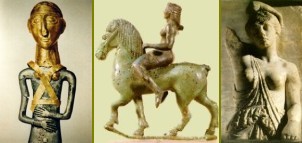
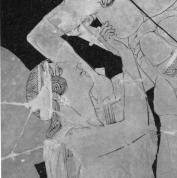
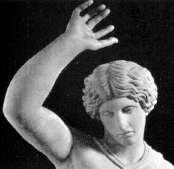
How did the ancient Greeks imagine the Amazons?There is a vast amount of literature on the Amazons, and there is an abundance of depictions of the Amazons in Greek art, particularly on vases and in sculptures.
=> Earliest depiction of an Amazon
The Amazons of the Thermodon River in Northern Turkey
It was always perfectly clear to the ancient Greeks where these famous Amazons had once lived. Their homeland lay at the mouth of the Thermodon River in northern Turkey. This location is so unambiguous that even today, the river’s Turkish name leaves no room for doubt. Today, the river is called Terme Çay. Çay is the Turkish name for »river«.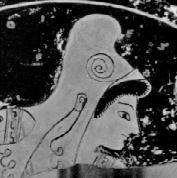
The Amazons of Lemnos
In ancient tradition, the island of Lemnos (also known as Limnos) is closely associated with the Amazons. The ancient Greeks regarded it as the «island ruled by women».
In the footsteps of the Amazons of Lemnos
=> Research campaign 2002
=> Research campaign 2003
=> Research campaign 2006 => The Figure Stone of Hephaistia
Samothrace - The Sacred Island of the »Great Mother«
=> Research campaign 2004 (PDF file - 587 KB)
The Amazons from Libya
There was a second instance of Amazons in antiquity. Long before Amazons lived along the Thermodon River, there were already Amazons in Libya.
=> In Search of Clues to the Homeland of the Libyan Amazons
=> Research campaign 2005 (PDF file - 621 KB)
=> The BERBERS - an ancient African people with a culture shaped by women
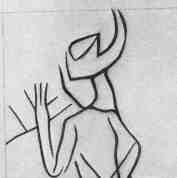
 These two characters of the ancient Tuareg script (Libyco-Berber script) are pronounced »AMAZA«.
In the Tuareg language, this word means »Mother's Love«.
These two characters of the ancient Tuareg script (Libyco-Berber script) are pronounced »AMAZA«.
In the Tuareg language, this word means »Mother's Love«.
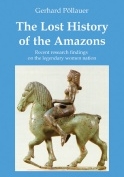
The Lost History of the Amazons
Recent research findings on the legendary women nation
This book follows in the footsteps of the legendary Amazons. It explores the famous Amazon legend in all its facets, embarks on an archaeological search for clues, and presents the latest research findings from the Amazons’ legendary homeland on the Thermodon River and from the island of Lemnos, which was once inhabited by Amazons. In-depth studies of ancient Amazon legends, combined with the latest on-site discoveries, unravel the mysterious myth surrounding this famous tribe of women. Numerous illustrations document the research findings.This latest research challenges the established view of history. Numerous archaeological and historical clues suggest that the Amazons really did exist! Based on these latest findings, the lost history of the Amazons can be reconstructed.
Copy with personal dedication:
=> direct order by e-mail
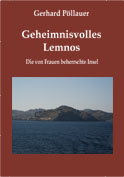
Geheimnisvolles Lemnos. Die von Frauen beherrschte Insel
Mysterious Lemnos. Island dominated by women
Located in the northern Aegean Sea, the relatively unknown Greek island of Lemnos boasts a magnificent prehistoric past. Five thousand years ago, a significant advanced civilization flourished here, featuring impressive urban complexes, massive rock-cut structures, and awe-inspiring sanctuaries. The discovery of the Early Bronze Age site at Poliochni is considered sensational. Due to its size and level of development, this settlement is considered the oldest city in Europe. Myrina in the west and Hephaistia in the north also impress with their astonishing prehistoric legacy. It is believed that a fourth urban settlement once existed in the far northeast of the island - the legendary Chryse, which sank into the sea following an earthquake. At the same time, it is evident that women played a role in this culture that was, at the very least, equal to that of men. It was not without reason that Lemnos was characterized in antiquity as »the island ruled by women«.This book is only available in German.
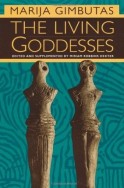
Marija Gimbutas, The Living Goddesses
Marija Gimbutas (1921 - 1994) was a serious, profound scholar who devoted her entire professional life to archaeological research; she possessed extensive knowledge not only in the field of archaeology but also in linguistics, ethnology, and the history of religion.
Her theories are well-thought-out, explained in straightforward terms, and supported by numerous archaeological artifacts.
She was professor of archaeology at UCLA (University of California, Los Angeles) from 1963 to 1989, and directed major excavations of Neolithic sites in southeastern Europe.

Elaine Morgan, The Descent of Woman
This pioneering work, first published in 1972 and revised in 1985, was the first
to argue, intelligently and irrefutably, the equal role of women in human evolution.
It created a worldwide furore and became a rallying point for women everywhere.
The book's influence has been profound and lasting.
It remains the key book in any discussion of women's place in society.
Matriarchy today
Matriarchal ways of life still exist in isolated pockets today. Unfortunately, however, due to cultural assimilation and advancing globalization, they are doomed to extinction. These remaining matriarchal cultures are living proof that female-dominated societies are a historical reality. The last tangible examples are the Minangkabau on Sumatra and the Moso in southwestern China.
The Moso in Southern China
A vivid picture of the matriarchal Moso culture is provided by the book:
Leaving Mother Lake. A Girlhood at the Edge of the World
Aside from the fact that the book itself is very entertaining, the autobiographical account by the Moso woman Erche Namu provides a deep insight into this distinctly matriarchal culture.
The German matriarchy researcher Heide Göttner-Abendroth has published her survey about the matriarchal
Moso in the book:
Matriarchat in Südchina (only available in German).
Together with a group of women she visited the isolated Moso people in 1993.
By interviewing the people they were able to trace the clear and obvious matriarchal structures.
Finally, here’s an interesting detail: In the Moso language
»Ama« is »Mother«. This is a remarkable coincidence with the name of the warlike tribe of women known as the Amazons.
Another parallel can be found among the Berbers, who were once organized along matriarchal lines. In the Berber language, the Berbers refer to themselves as Amazigh. All these correspondences suggest that the ancient word Ama once meant »Mother« in the strict sense and, furthermore, served as a term for »matriarchal culture« in a figurative sense.
The Minangkabau people of West Sumatra
The Minangkabau of Sumatra have a culture that admirably combines a matriarchal way of life with the Islamic religion. Since the 1980s, anthropologist Peggy Reeves Sanday has spent several months almost every year immersed in this culture. Her book Women at the Center: Life in a Modern Matriarchy provides us with a well-founded picture of this female-dominated culture and leaves little doubt that the term »matriarchy« is appropriate here.
Women at the Center: Life in a Modern Matriarchy
=> Giresun Adasi Project

Diese Seite gibt es auch auf deutsch
Copyright © 1997-2026 Amazon Research Center