Despite the fact that most ancient authors wrote only of the Amazons along the Thermodon River, there were a few who knew of Amazons who had once lived in Libya in North Africa.
However, the Libyan Amazons are said to have lived long before the Amazons of the Thermodon River!
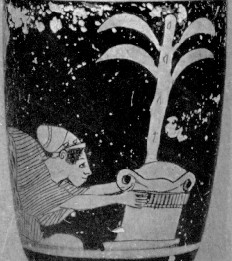
There is a depiction on a Greek vase that clearly shows a Negroid Amazon kneeling before an altar. A palm tree can be seen behind the altar. Thus, it seems quite clear that the artist depicted an African Amazon - apparently a Libyan Amazon.
In southwestern Libya, in the mountainous region of Fezzan, some very interesting and, in some cases, strange rock engravings have been discovered. These engravings must be very old. Today, this region is an inhospitable rocky desert where human life is impossible. These images must therefore have been created at a time when life was still possible there. The desertification of the landscape began about 4,000 years ago.
One of the engravings depicts a female figure wearing a pointed cap. In Greek depictions, such caps are worn by Amazons equipped as archers. Furthermore, this figure carries a bow - a favorite weapon of the Greek Amazons.
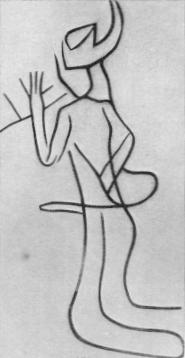
The resemblance to Greek Amazons is so striking that, were it not for the fact that this image was found approximately 1,000 kilometers south of the Mediterranean coast in the heart of the African continent, these depictions would be considered part of the same tradition.
Is there really any truth to the story that Amazons once lived in Africa, long before the Amazons of the Thermodon River?
The Lost History of the Amazons
Recent research findings on the legendary women nation
This book follows in the footsteps of the legendary Amazons. It explores the famous Amazon legend in all its facets, embarks on an archaeological search for clues, and presents the latest research findings from the Amazons’ legendary homeland on the Thermodon River and from the island of Lemnos, which was once inhabited by Amazons. In-depth studies of ancient Amazon legends, combined with the latest on-site discoveries, unravel the mysterious myth surrounding this famous tribe of women. Numerous illustrations document the research findings.This latest research challenges the established view of history. Numerous archaeological and historical clues suggest that the Amazons really did exist! Based on these latest findings, the lost history of the Amazons can be reconstructed.